CKS題庫下載 &新版CKS題庫上線
Wiki Article
P.S. PDFExamDumps在Google Drive上分享了免費的、最新的CKS考試題庫:https://drive.google.com/open?id=1fXR43OKP5I6dpzIhJwH-zTZtIwEq1f7g
即將參加Linux Foundation的CKS認證考試的你沒有信心通過考試嗎?不用害怕,因為PDFExamDumps可以提供給你最好的資料。PDFExamDumps的CKS考古題是最新最全面的考試資料,一定可以給你通過考試的勇氣與自信。这是经过很多人证明过的事实。
Linux Foundation CKS認證證書可以加強你的就業前景,可以開發很多好的就業機會。PDFExamDumps是一個很適合參加Linux Foundation CKS認證考試考生的網站,不僅能為考生提供Linux Foundation CKS認證考試相關的所有資訊,而且還為你提供一次不錯的學習機會。PDFExamDumps能夠幫你簡單地通過Linux Foundation CKS認證考試。
热门的CKS認證考試最新考古题产品 - 提供免费CKS题库demo下載
我們PDFExamDumps不僅僅提供優質的產品給每位CKS考生,而且提供完善的售後服務給每位考生,如果你使用了我們的產品,我們將讓你享受一年免費的更新,並且在第一時間回饋給每位考生,讓你及時得到更新的最新的考試資料,以最大效益的服務給每位CKS考生。
Linux Foundation CKS(經認證的Kubernetes安全專家)認證考試是一項行業認可的認證,可驗證候選人在確保容器化應用程序和Kubernetes平台方面的技能和知識。該考試旨在測試候選人在Kubernetes環境中識別和解決安全風險的能力,以及他們在實施安全控制和最佳實踐方面的熟練程度。
最新的 Kubernetes Security Specialist CKS 免費考試真題 (Q45-Q50):
問題 #45
Your application requires access to specific network resources, but you want to restrict its communication to only these allowed ports and IP addresses. Explain how to achieve this using AppArmor profiles.
答案:
解題說明:
Solution (Step by Step) :
1. Define the AppArmor Profile:
- Create an 'apparmor.conf file with the following content:
- This example allows connections to port 80 on the IP address '10.0.0.10' and port 443 on the IP address '192.168.1.1'.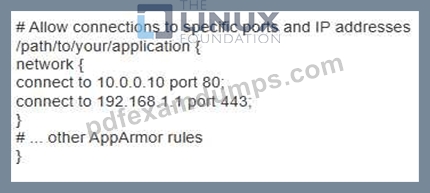
2. Apply the AppArmor Profile to the Container: - You can apply the AppArmor profile to the container using the 'securityContext' in your deployment or pod spec. - Include the following configuration: - 'securityContext.apparmor.profileName: my-app-profile'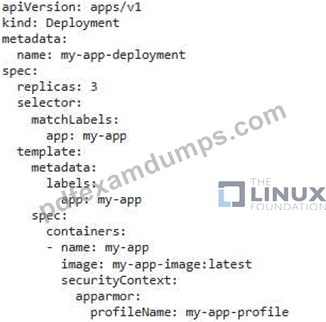
3. Load and Enable the Profile: - Use the following command to load the 'apparmor.conf file: - 'sudo apparmor_parser -r Ipath/to/apparmor.conr - Enable the profile for the container. - 'sudo aa-enforce my-app-profile' 4. Test and Verify: - Deploy the application with the AppArmor profile. - Attempt to access the allowed network resources. - Verify that the application can successfully connect to the specified ports and IP addresses. - Attempt to access other network resources that are not allowed. - Verify that the AppArmor profile blocks these attempts.
問題 #46
SIMULATION
Context
You must fully integrate a container image scanner into the kubeadm provisioned cluster.
Task
Given an incomplete configuration located at /etc/kubernetes/bouncer and a functional container image scanner with an HTTPS endpoint at https://smooth-yak.local/review, perform the following tasks to implement a validating admission controller.
First, re-configure the API server to enable all admission plugin(s) to support the provided AdmissionConfiguration.
Next, re-configure the ImagePolicyWebhook configuration to deny images on backend failure.
Next, complete the backend configuration to point to the container image scanner's endpoint at https://smooth-yak.local/review.
Finally, to test the configuration, deploy the test resource defined in /home/candidate/vulnerable.yaml which is using an image that should be denied.
You may delete and re-create the resource as often as needed.
The container image scanner's log file is located at /var/log/nginx/access_log.
答案:
解題說明:
See the Explanation below for complete solution
Explanation:
Below is the CKS exam style "do-this-exactly" runbook for Q3. It includes the minimal discovery commands (so you don't guess filenames), then the exact lines/blocks to set.
QUESTION 3 - ImagePolicyWebhook (Validating Admission) - Exam Steps
0) SSH + root
ssh cks000002
sudo -i
1) Identify the provided config files (no guessing)
ls -la /etc/kubernetes/bouncer
You are looking for files typically named like:
admission_configuration.yaml (AdmissionConfiguration)
imagepolicywebhook.yaml (ImagePolicyWebhookConfiguration) OR the ImagePolicyWebhook config embedded inside the AdmissionConfiguration kubeconfig (webhook kubeconfig) If unsure which is which, quick peek:
grep -R "ImagePolicyWebhook" -n /etc/kubernetes/bouncer
grep -R "AdmissionConfiguration" -n /etc/kubernetes/bouncer
grep -R "kubeconfig" -n /etc/kubernetes/bouncer
PART A - Reconfigure API Server to enable required admission plugin(s)
2) Edit API server static pod manifest
vi /etc/kubernetes/manifests/kube-apiserver.yaml
2.1 Enable the admission plugin ImagePolicyWebhook
Find the line starting with:
- --enable-admission-plugins=
Ensure ImagePolicyWebhook is included in that comma list.
Example (your list may differ; just add ImagePolicyWebhook):
- --enable-admission-plugins=NodeRestriction,ImagePolicyWebhook
If the flag does not exist, add one line under command::
- --enable-admission-plugins=ImagePolicyWebhook
2.2 Point API server to the provided AdmissionConfiguration
In the same file, ensure this flag exists (use the file in /etc/kubernetes/bouncer that contains AdmissionConfiguration):
- --admission-control-config-file=/etc/kubernetes/bouncer/admission_configuration.yaml If your file is named differently, use the real filename you found in step 1, but keep the flag name exactly --admission-control-config-file.
Save/exit:
:wq
Static pod will restart automatically (kubelet watches the manifest).
Optional quick watch:
docker ps | grep kube-apiserver
# or:
crictl ps | grep kube-apiserver
PART B - Configure ImagePolicyWebhook to deny images on backend failure
3) Edit the ImagePolicyWebhook config
One of these is true on your cluster:
Option 1 (most common in these tasks): ImagePolicyWebhook config is a standalone file Edit the file in /etc/kubernetes/bouncer that contains kind: ImagePolicyWebhookConfiguration:
grep -R "kind: ImagePolicyWebhookConfiguration" -n /etc/kubernetes/bouncer vi /etc/kubernetes/bouncer/<THE_FILE_YOU_FOUND>.yaml Set (or ensure) exactly:
defaultAllow: false
Option 2: ImagePolicyWebhook config is embedded inside AdmissionConfiguration Edit the AdmissionConfiguration file:
vi /etc/kubernetes/bouncer/admission_configuration.yaml
Find the plugin section for ImagePolicyWebhook and ensure the config includes:
defaultAllow: false
✅ Save/exit:
:wq
PART C - Point backend configuration to https://smooth-yak.local/review
4) Edit the webhook kubeconfig to use the scanner endpoint
Find the kubeconfig file referenced by the ImagePolicyWebhook config.
Search for kubeConfigFile:
grep -R "kubeConfigFile" -n /etc/kubernetes/bouncer
Open that kubeconfig path (example name below; yours may differ):
vi /etc/kubernetes/bouncer/kubeconfig
In kubeconfig, set the cluster server exactly:
clusters:
- cluster:
server: https://smooth-yak.local/review
✅ Save/exit:
:wq
PART D - Restart effect (make sure API server picks up config)
Because you already edited /etc/kubernetes/manifests/kube-apiserver.yaml, the API server restarted.
To be safe (and fast), force a restart by "touching" the manifest (no content change needed):
touch /etc/kubernetes/manifests/kube-apiserver.yaml
PART E - Test: apply vulnerable workload and confirm it is denied
5) Use admin kubeconfig (because old kubectl config may break)
export KUBECONFIG=/etc/kubernetes/admin.conf
kubectl get nodes
6) Deploy the test resource (should be DENIED)
kubectl apply -f /home/candidate/vulnerable.yaml
Expected: admission error/denied message.
If it already exists:
kubectl delete -f /home/candidate/vulnerable.yaml
kubectl apply -f /home/candidate/vulnerable.yaml
PART F - Verify the scanner was called (log check)
7) Check scanner access log
tail -n 50 /var/log/nginx/access_log
You should see requests hitting /review.
Quick "what to check if it doesn't deny"
Run these in order:
Confirm API server flags:
grep -n "enable-admission-plugins" /etc/kubernetes/manifests/kube-apiserver.yaml grep -n "admission-control-config-file" /etc/kubernetes/manifests/kube-apiserver.yaml Confirm deny-on-failure:
grep -R "defaultAllow" -n /etc/kubernetes/bouncer
Must show:
defaultAllow: false
Confirm endpoint:
grep -R "server: https://smooth-yak.local/review" -n /etc/kubernetes/bouncer API server logs (docker runtime):
docker ps | grep kube-apiserver
docker logs $(docker ps -q --filter name=kube-apiserver) --tail 80
If you paste the output of:
ls -/etc/kubernetes/bouncer
grep -R "kind: AdmissionConfiguration" -n /etc/kubernetes/bouncer
grep -R "ImagePolicyWebhook" -n /etc/kubernetes/bouncer
問題 #47
SIMULATION
On the Cluster worker node, enforce the prepared AppArmor profile
#include <tunables/global>
profile docker-nginx flags=(attach_disconnected,mediate_deleted) {
#include <abstractions/base>
network inet tcp,
network inet udp,
network inet icmp,
deny network raw,
deny network packet,
file,
umount,
deny /bin/** wl,
deny /boot/** wl,
deny /dev/** wl,
deny /etc/** wl,
deny /home/** wl,
deny /lib/** wl,
deny /lib64/** wl,
deny /media/** wl,
deny /mnt/** wl,
deny /opt/** wl,
deny /proc/** wl,
deny /root/** wl,
deny /sbin/** wl,
deny /srv/** wl,
deny /tmp/** wl,
deny /sys/** wl,
deny /usr/** wl,
audit /** w,
/var/run/nginx.pid w,
/usr/sbin/nginx ix,
deny /bin/dash mrwklx,
deny /bin/sh mrwklx,
deny /usr/bin/top mrwklx,
capability chown,
capability dac_override,
capability setuid,
capability setgid,
capability net_bind_service,
deny @{PROC}/* w, # deny write for all files directly in /proc (not in a subdir)
# deny write to files not in /proc/<number>/** or /proc/sys/**
deny @{PROC}/{[
順便提一下,可以從雲存儲中下載PDFExamDumps CKS考試題庫的完整版:https://drive.google.com/open?id=1fXR43OKP5I6dpzIhJwH-zTZtIwEq1f7g
Report this wiki page